

How Event Planners Coordinate Catering for Film and TV Productions


Film and television productions require precise coordination. Catering must support early call times, changing locations, fluctuating headcounts, dietary requirements, and tightly controlled meal breaks.
An event planner helps manage these requirements from the initial booking through the final cleanup. The planner acts as the operational connection between the production company, cast and crew, location managers, and catering team.
For production companies, the objective is straightforward: provide safe, suitable meals on schedule without disrupting the shoot.
What does an event planner manage for film and TV catering?
An event planner typically coordinates the following:
- Production dates and service times
- Daily cast and crew headcounts
- Catering budget and service scope
- Meal formats and menu requirements
- Dietary restrictions and allergies
- Delivery or chef arrival instructions
- Location access, parking, and setup areas
- Changes to the shooting schedule
- Cleanup and equipment removal
The planner should confirm these details before requesting a final catering quote. Incomplete information can result in incorrect quantities, unsuitable menus, or additional operational charges.
For smaller productions, commercial shoots, executive teams, or location-based projects, an event planner may coordinate directly with a private chef. Onyx Hospitality’s private chef service provides customized menus, preparation, serving, and cleanup in Toronto, Niagara, and Muskoka.
How does an event planner build a production catering brief?
A catering brief gives the chef or catering company the information required to plan accurately.
The event planner should include:
-
Production type
Identify whether the service is for a feature film, television production, commercial, music video, branded content shoot, photoshoot, or production office. -
Service dates
List every service date, including prep days, rehearsal days, night shoots, and pickup days. -
Location details
Provide the complete address, access instructions, parking restrictions, building rules, elevator information, and contact details for the location representative. -
Headcount
Provide the expected number of cast, crew, background performers, clients, agency representatives, and guests. Include a minimum, typical, and maximum estimate when numbers are not final. -
Meal requirements
Specify whether the production requires breakfast, lunch, dinner, snacks, a second meal, or only one scheduled meal. -
Service format
Confirm whether the food will be buffet-style, family-style, plated, individually packaged, or delivered in labelled meal boxes. -
Budget parameters
State whether the budget includes food, labour, travel, equipment, service staff, rentals, taxes, and cleanup.
A complete brief reduces follow-up communication and allows the catering team to identify operational limitations before the booking is confirmed.
How are catering times coordinated with the call sheet?
The call sheet is the primary scheduling reference for the production day. Catering times should be coordinated with the production schedule, not selected independently.
The event planner should confirm:
- Crew call time
- Expected meal-break time
- Estimated wrap time
- Travel time between base camp and set
- Unit moves or split units
- Talent availability
- Any scenes that restrict crew movement
- Required setup and breakdown times
Many productions plan the main meal within approximately six hours of crew call, depending on the applicable union agreement, production policy, and local requirements. The production team must confirm the rule that applies to its project.
If the schedule changes, the event planner should notify the catering team as early as possible. A delayed meal may require adjusted holding procedures, a revised service window, or a different menu format.
The planner should also confirm who has authority to release the crew for the meal. This may involve the production manager, first assistant director, line producer, or another designated department lead.
What is the difference between production catering and craft services?
Production catering and craft services have separate functions.
Production catering
Production catering usually provides substantial meals, such as:
- Breakfast
- Lunch
- Dinner
- Second meals for extended shooting days
- Hot snacks or “hot treats”
- Meals for cast, crew, clients, and production guests
Craft services
Craft services generally provides food and beverages that remain available throughout the day, including:
- Coffee and tea
- Water and soft drinks
- Fruit
- Granola bars
- Pastries
- Nuts and packaged snacks
- Non-dairy beverages
- Light hot items, where included
An event planner should confirm whether one supplier will provide both services or whether separate vendors will be used. The planner should also identify the location and operating hours for each food station.
Craft services may need to be positioned closer to the active set, while the main meal may be located at base camp or another designated service area.
How should event planners manage dietary requirements?
Dietary information should be collected before the menu is finalized. The planner should use a clear form or production questionnaire to record:
- Food allergies
- Ingredient intolerances
- Vegetarian requirements
- Vegan requirements
- Gluten-free requirements
- Halal requirements
- Kosher requirements
- Medical diets
- Talent-specific preferences
- Cultural or religious restrictions
The catering team should receive the information in a consolidated format. Sending separate, incomplete messages increases the risk of missed requirements.
Menus should identify major allergens and dietary categories. Separate utensils, containers, preparation areas, and service labels may be required for serious allergies or specific religious diets.
For smaller productions or private talent service, a private chef can review dietary needs directly and develop a customized menu. Onyx Hospitality states that its menus can be adapted to guest preferences and dietary requirements. Confirm the production’s requirements, service location, staffing needs, and available kitchen facilities before booking.
Which meal format works best on a production set?
The event planner should select the format based on schedule, location, headcount, staffing, and available facilities.
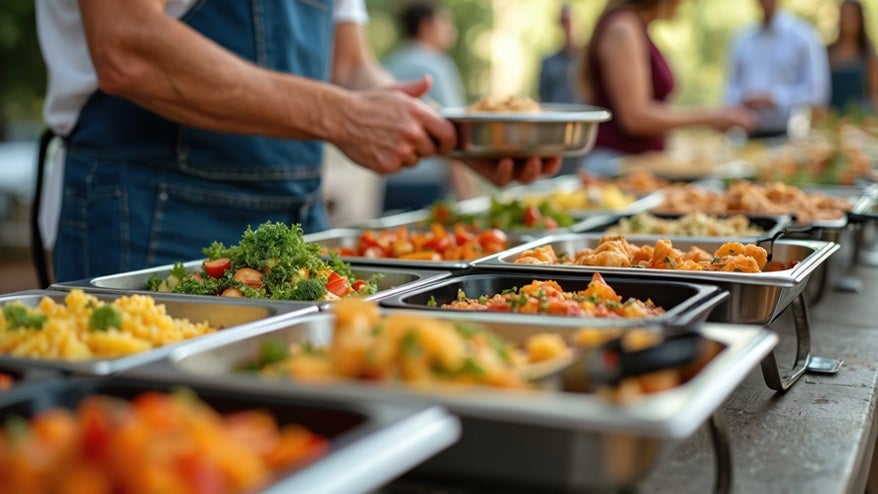
Buffet service
Buffet service is suitable when:
- The crew is eating at a central location
- There is sufficient space for a service line
- A range of menu options is required
- The production can provide a defined meal window
- Staff are available to monitor replenishment
Individually packaged meals
Individually packaged meals are suitable when:
- The crew is working in separate areas
- Meal breaks are staggered
- Distribution must be fast
- Individual dietary labelling is required
- There is limited service space
Plated or chef-served meals
Plated service may be appropriate for:
- Principal cast
- Directors and producers
- Client or agency groups
- Executive production meetings
- Private location shoots
- Small commercial productions
The event planner should confirm the expected service time and whether the production requires disposable, reusable, or rental tableware.

How does an event planner coordinate food at a remote location?
Remote catering requires additional planning. Before confirming service, the planner should verify:
- Road access for delivery vehicles
- Parking or unloading space
- Kitchen access
- Refrigeration
- Power supply
- Water access
- Waste disposal
- Weather protection
- Lighting for night service
- Distance from parking to the meal area
- Cell service or alternate communication methods
If the location has a functional kitchen, the chef may prepare meals on site. If not, food may be prepared elsewhere and transported for service. The planner must confirm how food will be transported, held, served, and removed.
For cottage, retreat, and remote-location productions in the Toronto, Niagara, or Muskoka areas, private chef service may be suitable for smaller groups requiring prepared meals at the location. The service page identifies full-day chef coverage for three meals, as well as dinner-only service. Availability, travel charges, menu pricing, staffing, and group size should be confirmed in advance.

How should catering budgets be structured?
An event planner should request an itemized quote. The quote should identify:
- Cost per person
- Number of meals
- Food and ingredients
- Chef or catering labour
- Servers and support staff
- Travel fees
- Equipment rentals
- Delivery charges
- Setup and cleanup
- Taxes
- Overtime or second-meal charges
- Cancellation or deposit terms
A lower per-person quote may exclude vehicles, staff, travel, equipment, or cleanup. Production companies should compare complete service scopes rather than comparing food prices alone.
Menu selection also affects cost. Premium proteins, specialized dietary meals, extended service hours, and remote travel may increase the total. An event planner can manage the budget by separating required services from optional upgrades and confirming the cost impact of each change.
What should the daily catering checklist include?
An event planner should complete the following checks for each service day:
- Confirm the next-day headcount
- Review the latest call sheet
- Confirm meal and delivery times
- Verify the service address
- Send access and parking instructions
- Confirm dietary meals
- Check weather and location conditions
- Confirm contact numbers
- Verify setup requirements
- Confirm payment or approval status
- Review cleanup and equipment removal
The planner should maintain one current version of the catering schedule. Changes should be sent to the catering lead, production office, location contact, and any staff responsible for meal release.
How can production companies book catering efficiently?
Production companies should book catering as early as possible, particularly for multi-day productions, remote locations, large crews, or specialized menus.
The recommended process is:
- Prepare the production catering brief.
- Confirm the initial headcount range.
- Identify dietary and talent requirements.
- Request itemized quotes.
- Confirm service format and staffing.
- Review travel and location logistics.
- Approve the menu and terms.
- Pay the required deposit.
- Send rolling headcounts and call sheets.
- Confirm final details before each service date.
An event planner provides the structure required to keep these steps organized. The catering team can then focus on preparation, service, food quality, and cleanup.
For a private chef inquiry covering Toronto, Niagara, or Muskoka, review the Onyx Hospitality private chef service and submit the available inquiry details, including location, guest count, meal type, dates, service duration, and staffing requirements.
Frequently Asked Questions About Film and TV Production Catering
1. What does film production catering include?
Film production catering may include breakfast, lunch, dinner, hot snacks, second meals, beverages, setup, service, and cleanup. The exact scope depends on the production schedule and approved budget.
2. What does an event planner do for a film set caterer?
An event planner provides the schedule, headcount, dietary information, location details, budget, service format, and daily updates. The planner also communicates changes and confirms that catering aligns with the call sheet.
3. How early should a production book catering?
Book as early as possible. Multi-day productions, large crews, remote locations, and specialized menus require additional planning. Final headcounts should be updated as soon as they are available.
4. Should film catering be buffet-style or individually packaged?
Both formats can be effective. Buffet service provides variety and can support large groups. Individually packaged meals support staggered breaks, fast distribution, and clear dietary labelling.
5. Does film catering include craft services?
Not automatically. Craft services may be provided by the main caterer or by a separate supplier. Confirm the scope before approving the quote.
6. How are dietary restrictions handled on set?
Dietary requirements should be collected before menu approval. Meals should be clearly labelled, and separate preparation or serving procedures may be required for serious allergies and specific dietary standards.
7. Can a private chef cater a small film production?
A private chef may be suitable for smaller shoots, private locations, executive groups, or talent meals. Confirm group size, kitchen access, travel, menu requirements, service duration, and staffing before booking.
8. What information does a caterer need from a production company?
The caterer needs service dates, locations, headcounts, meal times, menu requirements, dietary information, access instructions, budget parameters, service format, and contact details for the production representative.


